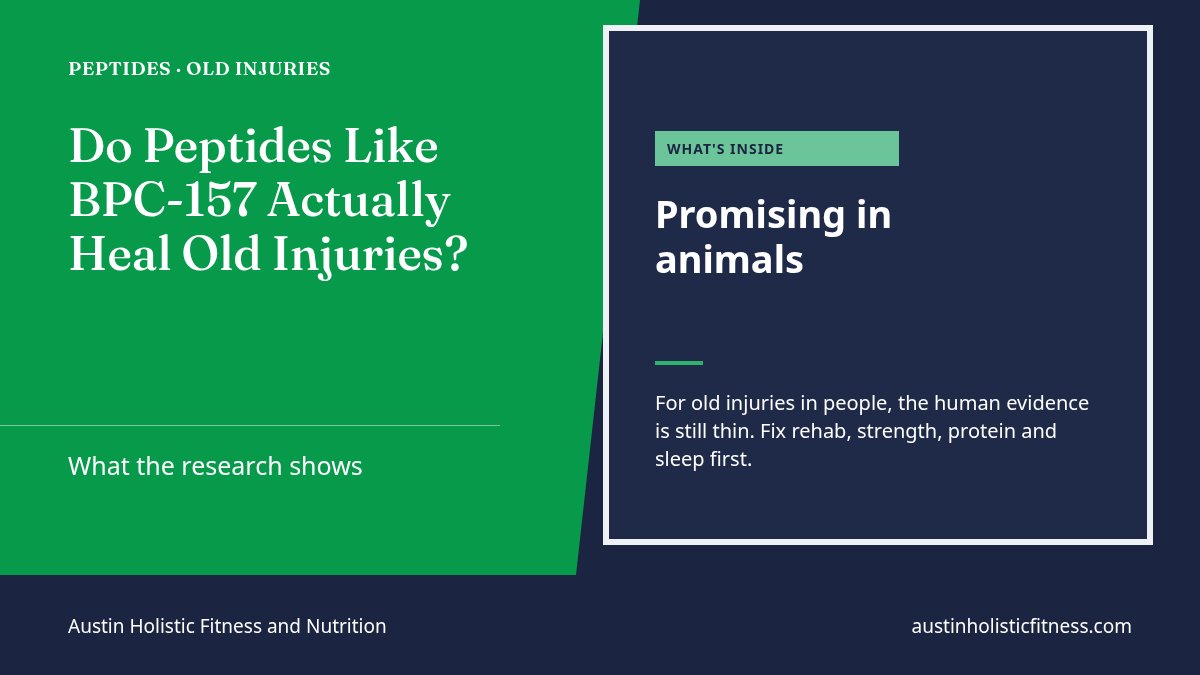
Do Peptides Like BPC-157 Actually Heal Old Injuries?
My honest take: some peptides look promising in animals, but for old injuries in people, the human evidence is still very thin, and the risks of what's actually in the vial are real. The things with strong human evidence for an old shoulder or ankle are the boring ones: the right rehab exercise, strength training, enough protein, and sleep. Fix that base first. If you and your doctor still decide to try a peptide after that, you'll have given your body what it needs to heal, and you'll be able to tell whether the peptide did anything.
A conversation at the gym
This week I talked with a 63-year-old guy at my gym. He's got old injuries in his shoulder and ankle, and he wants to try peptides to help them heal.
I get it. The stories sound amazing. We talked about doing my program plus proper corrective exercise for that shoulder and ankle first. In my experience, when the base is in place, people get more out of whatever they add on top.
That's my coaching view, not a proven medical fact. I couldn't find any study that tested "rehab first, then peptides." So let's look at what we do know.
What are peptides, anyway?
Peptides are short chains of amino acids, and some are approved medicines, like insulin and the GLP-1 drugs. The ones people talk about at the gym, like BPC-157, TB-500, GHK-Cu, CJC-1295 and ipamorelin, aren't FDA-approved for healing injuries or slowing aging [8][17].
What does the research actually show?
For most popular "healing" peptides, the evidence is mostly from rats, lab dishes and a few tiny human reports.
BPC-157. A 2025 systematic review found 36 studies. Thirty-five were in animals or labs, and only one was in people [1]. The animal results for tendons, ligaments, muscle and bone look genuinely encouraging [1][3].
The human side is small. A 2026 review found three human studies, 30 people total, no control groups, and "very low" certainty of evidence [2]. In the best-known one, 16 people with knee pain got a BPC-157 injection at a clinic, and most said by phone that it helped [4]. With no comparison group, we can't separate the peptide from time or expectation. A safety study gave it by IV to just two people [5].
USADA, the U.S. anti-doping agency, says no human trials have shown BPC-157 works for any condition, and nobody knows whether there's a safe dose [6].
TB-500 (a piece of thymosin beta-4). The full thymosin beta-4 protein has some human data, mostly as a topical treatment for skin ulcers in small phase 2 trials [7]. TB-500 is only a fragment of it. The FDA says it hasn't found any human exposure data for that fragment [8].
GHK-Cu. This copper peptide has decent human data as a skin cream, with less wrinkling and thicker skin in 12-week studies [9]. For injections, the FDA says human data are limited [8].
CJC-1295, ipamorelin and MK-677 (growth hormone boosters). CJC-1295 and MK-677 do raise growth hormone and IGF-1 in people [10][11]; ipamorelin has much less published human data [8]. Raising a number isn't the same as healing a shoulder, though. In a year-long trial in adults aged 60 to 81, MK-677 added about a kilogram of lean mass, but strength and function didn't improve. Blood sugar went up, and some people had leg swelling and a bigger appetite [11]. A trial in older adults recovering from hip fractures was stopped early over a possible heart failure signal [12].
What about the success stories?
The success stories are real experiences, but anecdotes can't tell you what caused the change. Old injuries often improve with time, rest or a new routine, and expecting a treatment to work can ease pain on its own. That doesn't mean peptides do nothing. It means we don't know yet. The recent reviews agree: promising in animals, investigational in humans [1][2][3].
What are the real risks?
The biggest risks we know about today come from quality and unknowns, not from proven side effects.
What's in the vial. Many peptides are sold as "research use only," even with dosing instructions included. The FDA warns these products are of unknown quality and may be harmful [20]. Even HHS says its new policy is partly meant to steer people away from them [18].
Injections. In 2025, two women needed breathing tubes after peptide injections at a Las Vegas anti-aging festival. Both recovered. Regulators couldn't test the product, so they never learned whether it was contamination, an allergic reaction or the peptide itself [16].
Growth signals, in theory. BPC-157 helps grow new blood vessels in lab and animal studies, which may be part of how it helps tendons [13][3]. Tumors need new blood vessels too, so researchers flag this as a theoretical concern [3], and thymosin beta-4 shows up at higher levels in some spreading cancers [14]. For growth hormone, an expert panel found no link to cancer when it's used to treat a diagnosed deficiency [15]. So this risk is unproven either way. If you've had cancer, talk to your oncologist first.
Blood sugar and water. Growth hormone boosters can raise blood sugar and cause swelling [11]. That matters if you have prediabetes or diabetes.
Sports. If you compete in tested sports, BPC-157, TB-500, CJC-1295, ipamorelin and MK-677 are all banned at all times [19].
What about GLP-1 peptides?
GLP-1 drugs are the best-studied peptides out there, and they still come with trade-offs. In the big semaglutide trial, nausea and diarrhea were most common, usually mild and fading over time [21]. The bigger issue after 60 is muscle: more than a quarter of weight lost on these drugs typically comes from lean mass [22].
Compounded versions add risk. The FDA has reports of hospitalizations tied to dosing mistakes, plus fake pharmacy labels and counterfeits [20]. Safety reports also show more hospitalizations with compounded GLP-1s, though that data can't prove cause [23]. I call a GLP-1 a tailwind, not the map. It doesn't replace the strength training and protein that protect your muscle.
What's the legal status right now?
The rules are in flux, and "allowed to be compounded" still doesn't mean "proven safe." In 2023, the FDA flagged BPC-157, TB-500 and others as possible significant safety risks for compounding [8][18]. On October 30, 2026, HHS said it won't take action against licensed pharmacies and doctors compounding six peptides, including BPC-157 and TB-500, under strict conditions, even though FDA's drug center recommended against it [17][18]. It's an interim policy, not an FDA approval [17].
Why does the base matter so much after 60?
For an old shoulder, an old ankle and aging muscle, exercise has the strong human evidence. Here's what the research shows.
Shoulder: In a trial of people over 55 with non-traumatic rotator cuff tears, physical therapy alone did as well as surgery at one year [29].
Ankle: Exercise and bracing have the best evidence for preventing repeat ankle sprains [30].
Tendons: For chronic Achilles pain, 12 weeks of heavy, slow strength work helped as much as the classic eccentric program, and people stuck with it better [28].
Muscle: A Cochrane review of 121 trials found strength training gives older adults a large strength boost and makes getting out of a chair easier [26].
Protein: Experts recommend at least 1.0 to 1.2 grams of protein per kilogram of body weight a day for adults over 65, and more if you're active [27]. If you have kidney disease, check with your doctor first.
Collagen peptides, a food-based peptide, have real trials behind them. In men in their 70s with low muscle mass, adding 15 grams a day to 12 weeks of strength training gave more lean mass and strength than training alone, though both groups improved [24]. In a small study, gelatin with vitamin C taken an hour before exercise doubled a marker of collagen building [25].
Here's how I think about it. Adding a healing booster to a body that isn't sleeping, eating enough protein or loading the injured tissue is like fertilizing a lawn you never water. Tendons and muscles heal in response to the right load, enough protein and enough rest, so that comes first.
Weighing it out
Fix the base, get a real diagnosis, and treat peptides as an experiment, not a shortcut.
Promising: BPC-157 in animals, GHK-Cu skin creams, collagen with strength training.
Unproven: peptides healing old human injuries, long-term safety, research-use purity.
Well supported: strength work, targeted rehab and enough protein.
I'm a holistic coach, not a doctor, and I don't prescribe medications. I've coached since 2001, and my degree is a BS in Kinesiology and Nutrition. Please talk to your doctor before you start any peptide, especially if you take other medications, have diabetes or have a history of cancer.
Your game plan
Get the injury looked at. A doctor or physical therapist can tell you what's actually going on in the shoulder or ankle.
Do corrective work and progressive strength training for 8 to 12 weeks. Tendons and muscles respond to slow, steady load.
Eat enough protein, spread across your meals, and protect your sleep.
Track how it feels. Write down pain, range of motion and what you can do, so you have a real before and after.
If you still want peptides, do it with your doctor. Use a licensed pharmacy, never research-use vials, try one change at a time, and report any side effects.
If you want help building that base, it's what the 8-Week Program is for. We bring exercise back once eating is steady, and we fix how you move before you load it. You can also book a free 15-minute call. No pressure either way.
Know someone at your gym asking about peptides? Send this their way.
Sources
Vasireddi N, et al. Emerging Use of BPC-157 in Orthopaedic Sports Medicine: A Systematic Review. HSS J. 2025. https://pubmed.ncbi.nlm.nih.gov/40756949/
Poolton JT, et al. Human evidence for BPC-157 in orthopaedic and regenerative medicine: a systematic review of efficacy and safety. Acta Orthop Belg. 2026. https://pubmed.ncbi.nlm.nih.gov/42885452/
McGuire FP, et al. Regeneration or Risk? A Narrative Review of BPC-157 for Musculoskeletal Healing. Curr Rev Musculoskelet Med. 2025. https://pubmed.ncbi.nlm.nih.gov/40789979/
Lee E, Padgett B. Intra-Articular Injection of BPC 157 for Multiple Types of Knee Pain. Altern Ther Health Med. 2021. https://pubmed.ncbi.nlm.nih.gov/34324435/
Lee E, Burgess K. Safety of Intravenous Infusion of BPC157 in Humans: A Pilot Study. Altern Ther Health Med. 2025. https://pubmed.ncbi.nlm.nih.gov/40131143/
USADA. BPC-157: What Athletes Should Know About the Prohibited Experimental Peptide. https://www.usada.org/spirit-of-sport/bpc-157-peptide-prohibited/
Treadwell T, et al. The regenerative peptide thymosin β4 accelerates the rate of dermal healing in preclinical animal models and in patients. Ann N Y Acad Sci. 2012. https://pubmed.ncbi.nlm.nih.gov/23050815/
FDA. Certain Bulk Drug Substances for Use in Compounding that May Present Significant Safety Risks (Category 2 list). https://www.fda.gov/drugs/human-drug-compounding/certain-bulk-drug-substances-use-compounding-may-present-significant-safety-risks
Pickart L, Margolina A. Regenerative and Protective Actions of the GHK-Cu Peptide in the Light of the New Gene Data. Int J Mol Sci. 2018. https://pmc.ncbi.nlm.nih.gov/articles/PMC6073405/
Teichman SL, et al. Prolonged stimulation of GH and IGF-I secretion by CJC-1295 in healthy adults. J Clin Endocrinol Metab. 2006. https://pubmed.ncbi.nlm.nih.gov/16352683/
Nass R, et al. Effects of an oral ghrelin mimetic on body composition and clinical outcomes in healthy older adults: a randomized trial. Ann Intern Med. 2008. https://pubmed.ncbi.nlm.nih.gov/18981485/
Adunsky A, et al. MK-0677 (ibutamoren mesylate) for the treatment of patients recovering from hip fracture. Arch Gerontol Geriatr. 2011. https://pubmed.ncbi.nlm.nih.gov/21067829/
Hsieh MJ, et al. Therapeutic potential of pro-angiogenic BPC157 is associated with VEGFR2 activation and up-regulation. J Mol Med. 2017. https://pubmed.ncbi.nlm.nih.gov/27847966/
Xiao Y, et al. Thymosin β4: a potential molecular target for tumor therapy. Crit Rev Eukaryot Gene Expr. 2012. https://pubmed.ncbi.nlm.nih.gov/22856429/
Boguszewski CL, et al. Safety of growth hormone replacement in survivors of cancer and intracranial and pituitary tumours: a consensus statement. Eur J Endocrinol. 2022. https://pubmed.ncbi.nlm.nih.gov/35319491/
Damon A. Nevada Regulators Fine Peptide Providers at Anti-Aging Festival Where Two Women Became Critically Ill. ProPublica, Mar 13, 2026. https://www.propublica.org/article/raadfest-peptide-injections-nevada-fines
HHS. Notice of availability: Enforcement Discretion Policy Regarding 503A Compounding Using Certain Peptide Bulk Drug Substances. Federal Register, Oct 30, 2026. https://www.federalregister.gov/documents/full_text/html/2026/10/30/2026-22192.html
Venable LLP. In-Depth Analysis: HHS Announces Interim Enforcement Discretion for Section 503A Compounding with Certain Peptide Bulk Drug Substances. Nov 6, 2026. https://www.venable.com/insights/publications/2026/11/hhs-announces-interim-enforcement-discretion
World Anti-Doping Agency. 2026 Prohibited List. https://www.wada-ama.org/sites/default/files/2025-09/2026list_en_final_clean_september_2025.pdf
FDA. FDA's Concerns with Unapproved GLP-1 Drugs Used for Weight Loss. https://www.fda.gov/drugs/postmarket-drug-safety-information-patients-and-providers/fdas-concerns-unapproved-glp-1-drugs-used-weight-loss
Wilding JPH, et al. Once-Weekly Semaglutide in Adults with Overweight or Obesity (STEP 1). N Engl J Med. 2021. https://pubmed.ncbi.nlm.nih.gov/33567185/
Stefanakis K, et al. The impact of weight loss on fat-free mass, muscle, bone and hematopoiesis health. Metabolism. 2024. https://pubmed.ncbi.nlm.nih.gov/39481534/
McCall KL, et al. Safety analysis of compounded GLP-1 receptor agonists: a pharmacovigilance study using FAERS. Expert Opin Drug Saf. 2026. https://pubmed.ncbi.nlm.nih.gov/40285721/
Zdzieblik D, et al. Collagen peptide supplementation in combination with resistance training improves body composition and increases muscle strength in elderly sarcopenic men. Br J Nutr. 2015. https://pubmed.ncbi.nlm.nih.gov/26353786/
Shaw G, et al. Vitamin C-enriched gelatin supplementation before intermittent activity augments collagen synthesis. Am J Clin Nutr. 2017. https://pubmed.ncbi.nlm.nih.gov/27852613/
Liu CJ, Latham NK. Progressive resistance strength training for improving physical function in older adults. Cochrane Database Syst Rev. 2009. https://pubmed.ncbi.nlm.nih.gov/19588334/
Bauer J, et al. Evidence-based recommendations for optimal dietary protein intake in older people (PROT-AGE). J Am Med Dir Assoc. 2013. https://pubmed.ncbi.nlm.nih.gov/23867520/
Beyer R, et al. Heavy Slow Resistance Versus Eccentric Training as Treatment for Achilles Tendinopathy: A Randomized Controlled Trial. Am J Sports Med. 2015. https://pubmed.ncbi.nlm.nih.gov/26018970/
Kukkonen J, et al. Treatment of non-traumatic rotator cuff tears: a randomised controlled trial with one-year clinical results. Bone Joint J. 2014. https://pubmed.ncbi.nlm.nih.gov/24395315/
Doherty C, et al. Treatment and prevention of acute and recurrent ankle sprain: an overview of systematic reviews with meta-analysis. Br J Sports Med. 2017. https://pubmed.ncbi.nlm.nih.gov/28053200/